Don't let your fear of this barbecue technique make your dinner plans go up in smoke. The skills required for smoking and grilling are remarkably similar. So how does a smoker work? The best smokers help you cook food slow and low (180°F to 250°F) in a smoky chamber to infuse foods with flavor. Think of smoking food like the alfresco answer to your indoor slow cooker appliance, with a bonus kiss of smoke.
Unlike the typical grilled recipe, which cooks at 400°F to 550°F, smoked recipes involve cooking at a low heat created by the smoke itself as the wood chips or chunks smolder rather than burn. (Don't miss our complete guide on how to smoke food for the ultimate cookouts.)
Here is a summary of the main outdoor cooking styles:
- Grilling: Use a heat source below a grill grate, on which you cook food with the lid open.
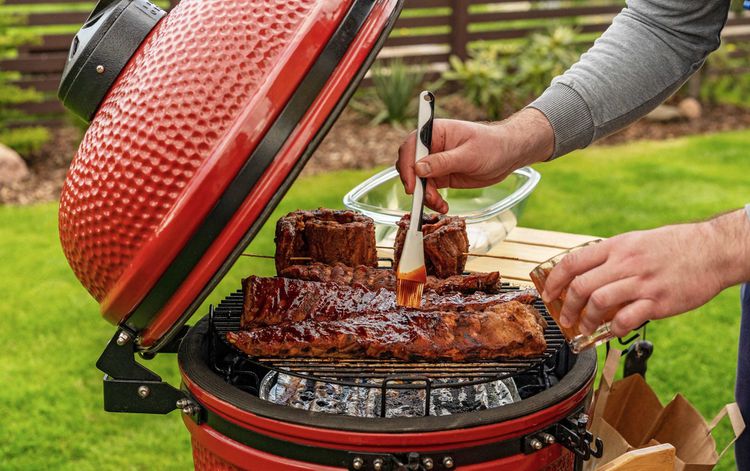
- Barbecuing: Use a heat source below a grill grate, on which you cook food with the lid closed to keep the toasty air and smoke inside.
Smoking is a form of barbecuing that relies on smoke from wood chips (sometimes in addition to another fuel agent, such as charcoal) rather than a heat source like charcoal or gas alone. This wood lends that signature extra layer of flavor.
The Different Types of Smokers
There are two main styles of smokers: Wet smokers and dry smokers. From there, the different types of smokers vary based on the materials used to construct the smoker and the cooking method. They include:
- Propane gas smokers are vertical smokers that look a bit like a heavy-duty safe with a temperature gauge on the outside.
- Charcoal smokers (including cabinet-style, firebox, barrel and drum, and bullet) can be either vertical or horizontal. Vertical charcoal smokers come in a variety of shapes like large drums, heavy-duty safes, and large eggs. Horizontal charcoal smokers look much like a grill with a chimney.
- Pellet smokers are horizontal smokers that look much like a grill with a chimney.
- Ceramic smokers, such as the Big Green Egg Smoker, are vertical smokers shaped like a large egg.
- Electric smokers are vertical smokers that may resemble a small fridge with various shelves, a heavy-duty safe, or a big drum depending on the brand.
How Does a Smoker Work?
Water smokers add moisture to the smoking process and are substantially less expensive than most pit smokers. They feature a cylindrical barrel about 2½ to 3½ feet high and about 18 inches in diameter and are set on a base that acts as the heat source, either charcoal, gas, or electric. Wood chips or chunks (and sometimes other aromatics like fresh herbs and citrus peels) are placed above the heat source to enhance desired smoky flavor, then the water pan goes above that. Lastly, a grill rack is the final element. That's where you'll put the food you're smoking, such as salmon, ribs, or brisket.
Dry smokers cook food by indirect grilling. These smokers have two chambers—one large chamber where food is placed, and a smaller offset fire chamber where the fuel source (again, charcoal, gas, or electric) heats the food chamber indirectly. Compared to most wet smokers, you can cook more food at one time.
All smokers have dampers, which add or limit the amount of airflow that's allowed into the smoker chambers. This is how you control the smoker's temperature. When the bottom damper is open, more air can reach the fire, which will increase the temperature. When the top damper is open, more air and heat will be able to escape, which can lower the heat.
Keep in mind that any time you open the lid, the temperature inside the smoker drops—and can take quite some time (and additional fuel) to get back up to speed. This is where a temperature probe comes in handy since you can monitor the internal temperature of your food without opening and closing the lid several times.
How a Smoker Works, Step-by-Step
- Preheat your smoker for 15 minutes.
- Adjust the heat to be tailored to your smoked food recipe, generally between 200°F and 220°F.
- Add dry wood chunks. Specific nut woods (walnut, pecan) or fruit woods (apple, cherry) are sold for smoking food. These can be found online and at most home supply stores.
- Stoke your smoke with some moisture. Some cooks use a water pan on a metal rack above the heat source to make a more humid environment, which allows the meat to absorb even more flavor and helps create that coveted smoke ring.
- Take your time. It can take hours to nearly a day to smoke meat to a safe internal temperature, depending on the size. Patience is key. Use this USDA-recommended internal temperature recommendation as your guide to tell when food is done.
The Best Smokers for Beginners
So now that you're aware of how a meat smoker works and all of the best types of smokers, you can narrow down options to meet your match. There are almost as many smokers on the market as there are delicious smoked recipes to cook on them. When trying to pinpoint the best smoker to invest in as you enter into smoking meats, fish, and more at home, look for these features—the qualities of the best smokers for beginners and beyond.
- Heavy-gauge metal, usually steel
- Smooth porcelain enamel inside and out for durability
- Tight-fitting lid to hold in smoke and heat
- Built-in temperature gauge to monitor heat inside
- Access to lower half of barrel for ease of adding wood, water, or charcoal as needed
- Trays for catching and disposing of ashes
- Sufficient vents to help regulate heat and smoke
Now that you know more about the different types of charcoal smokers, gas smokers, pellet smokers, and electric smokers, plus what makes them different from a basic barbecue grill, you're all set to buy a new smoker (or convert your grill to a smoker) and become a pro-level backyard pitmaster.
New